Whistlelink webinars – a practical guide to whistleblowing Register now
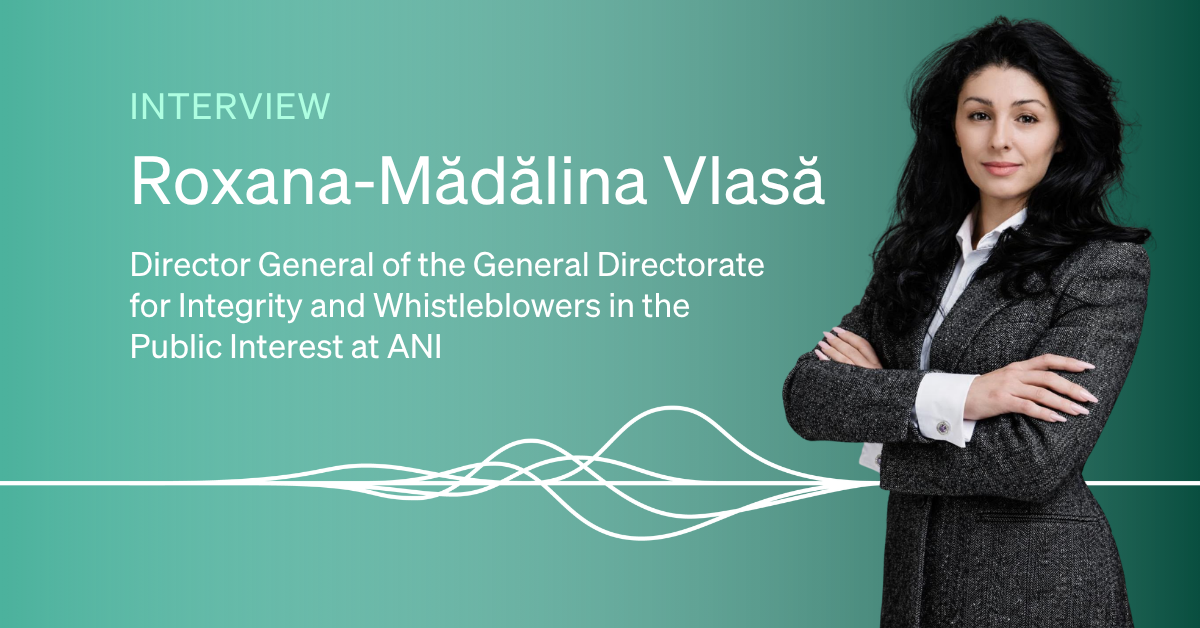
Romania transposed the EU Whistleblower Protection Directive through Law No. 361/2022. The National Integrity Agency (ANI) is one of the central authorities applying it and, since June 2026, has run Avertizori361, the national platform for external reporting. We spoke to Roxana-Mădălina Vlasă, Director General of the General Directorate for Integrity and Whistleblowers in the Public Interest at ANI, about ANI’s role, what the data shows and how organisations can make internal reporting work.
Many readers know ANI for its work on asset declarations and conflicts of interest. What is its role under Law No. 361/2022?
Law No. 361/2022 on the protection of whistleblowers in the public interest was an important step for Romania’s integrity framework. It created a reporting and protection mechanism for both the public and private sectors, and made ANI one of the central authorities in the national external reporting system.
This work is carried out by a dedicated unit, the Directorate for Whistleblowers in the Public Interest. It manages external reports, examines and resolves those within ANI’s remit, and redirects the rest to the competent authority. It also stays in contact with whistleblowers, asking for further information and keeping them informed of the follow-up.
We also support public and private organisations in applying the law, advising on reporting procedures and training the people who handle reports. We inform and advise people considering a report on procedures, choosing the right channel, protection measures, and their rights and remedies. In addition, we monitor how the law is applied, collect statistics, raise awareness and sanction administrative offences.
Our aim is a coherent national system in which organisations know how to handle reports properly, and people who report can genuinely rely on confidentiality and protection.
ANI has launched Avertizori361 as the national platform for external reporting. What problem does it solve, how does it protect reporters’ identities, and what should organisations and employees know about it?
The launch of Avertizori361 in June 2026 was an important moment for whistleblower protection in Romania and a significant step in digitalising the work of the competent authorities.
It is the first integrated national IT system for handling external reports under the law, bringing 50 competent authorities together in one shared digital infrastructure. Our aim was to overcome the fragmentation of external reporting and give both whistleblowers and authorities a modern, secure and accessible tool.
Whistleblowers can report by name or anonymously, at any time, and then communicate securely with the staff handling their report. With a unique access code, they can read messages, submit further documents and follow the report’s progress.
Protecting the whistleblower’s identity was a fundamental principle in developing the platform. It uses GlobaLeaks technology, with built-in safeguards for information security, access control and secure communication. For the authorities, it digitalises the whole process, from registering reports to managing cases and producing statistics.
It is important to note that the platform is for external reporting. It does not replace organisations’ obligation to set up and manage their own internal reporting channels.
External reports have grown every year, reaching 329 in 2025. How do you interpret this, and which areas are reported most often?
Data centralised by ANI show a significant increase in the use of external reporting channels. The competent authorities recorded 47 external reports in 2023 and 99 in 2024. In 2025 they recorded 329, of which 188 concerned matters within the scope of the law.
The areas reported most often in 2025 were:
Reports from the private sector received directly through ANI’s external channel also rose, from 18 in 2024 to 34 in 2025.
This may reflect greater awareness of the reporting mechanisms and greater willingness to use them. However, more reports should not automatically be read as more breaches of the law. For us, the data helps us understand how the national system works and decide where to focus our information and advisory work.
What are the main obstacles to effective internal reporting in Romanian organisations? Are they mainly technical and financial, or cultural?
In our experience, one of the main challenges is moving from formally setting up internal channels to making them work in practice. Technical and organisational aspects matter, but a channel or procedure on its own does not make a mechanism effective.
A significant challenge is understanding the scope of the law, and distinguishing reports under Law No. 361/2022 from other complaints, grievances or requests, which fall under separate legal regimes. In our dialogue with organisations, including in the private sector, other difficulties have come up: designating responsible persons, ensuring their independence, protecting confidentiality, handling reports and keeping the reporting mechanism separate from disciplinary proceedings.
Organisational culture, however, plays a decisive role. Fear of retaliation, lack of trust in an impartial examination, or the view that reporting is disloyal can all discourage people from using internal channels. Responsible reporting should instead be seen as a way to identify risks and improve how organisations work.
Trust in a reporting channel does not come from its existence alone. It is built through the way the organisation responds when it receives a report.
Why does internal reporting matter, and what does an organisation gain when problems are raised and resolved internally first? When should someone go directly to an authority through Avertizori361?
Internal reporting matters because it gives organisations the opportunity to identify and remedy possible breaches of the law at an early stage. A functioning internal mechanism can help reduce risks and improve organisational processes.
However, the law gives whistleblowers the right to choose between the internal and the external channel, depending on their circumstances and the risk of retaliation. Using the internal channel is not a mandatory precondition for making an external report.
A person may report directly to a competent authority when they consider this the right course in their situation, for example because of the risk of retaliation or whether the breach can be effectively remedied. Avertizori361 makes the national external reporting system easier to access.
For ANI, the two mechanisms are complementary. Both must work in a way that lets people choose the appropriate channel while benefiting from the legal guarantees.
What should compliance officers and management do to meet their legal obligations on internal reporting, and to make sure their channels are trusted and used?
First, organisations must make sure their internal reporting mechanisms are designed and managed in line with the law, not just in place on paper. That means accessible and secure channels, responsible persons who can act impartially and independently, protection of the whistleblower’s identity, and meeting the deadlines and obligations for follow-up.
Organisations may use separate mechanisms for employment, disciplinary or other compliance complaints. These must be handled under their own legal rules and not confused with the special reporting procedure under Law No. 361/2022.
The people who receive and handle reports must be properly trained, and information about the available channels and procedures must be communicated clearly to those who can use them.
We have consistently supported organisations in this process. In 2025 alone, ANI carried out 117 advisory activities for public and private entities, and in 2026 we have continued with training and dialogue, including sessions for local public administration, public enterprises and the private sector.
Our message to organisations is that an effective internal channel must offer more than a way to submit a report. It must guarantee a credible process for examining and handling the information received.
What would you say to an employee who has witnessed a breach of the law but hesitates to report it? What protection and support can they rely on?
First, I would say that reporting a possible breach of the law, under the conditions set out in Law No. 361/2022, means exercising a right that the law recognises and protects.
We understand that deciding to report can be difficult, especially for someone who fears professional or personal consequences. That is precisely why the law guarantees the confidentiality of the whistleblower’s identity, prohibits retaliation and provides access to protection and remedies. People who believe they have suffered retaliation can challenge it, including in court.
Access to free legal aid, in the cases provided for by law, is also important. ANI has worked with the National Union of Romanian Bar Associations and its member bars to support consistent application of this mechanism. We also advise anyone considering a report or wanting to understand the protection available.
Whistleblower protection must not remain merely a guarantee written into legislation. It must be a real possibility to exercise one’s rights when people need it.
What are ANI’s priorities for the coming years?
Our priority is to strengthen the national external reporting system and, above all, to make sure the protection guaranteed by the law works in practice. That includes making full use of Avertizori361, continuing our training and advisory work, and monitoring how protection measures and remedies are applied, including in case law.
In the long term, we want reporting mechanisms to be seen not merely as compliance obligations, but as natural tools for strengthening integrity and accountability in organisations.
The true effectiveness of a whistleblower protection system is not measured by the number of reports alone, but by the ability of institutions and organisations to handle them properly and to respect the rights of those who choose to report breaches of the law.
More information about the National Integrity Agency is available on its website, integritate.eu.
Whistlelink values your privacy. We will only contact you about our solutions.


Get a 30-minute walkthrough of Whistlelink.
Whistlelink values your privacy. We will only contact you about our solutions.

Talk with Territory Manager Annelie Demred

Questions about which plan is right for your organisation, or how to get the most out of Whistlelink?
→ Or go to our page with Frequently Asked Questions
Do you need quick answers about the product or are you experiencing any issues? We’re here to help.
For confidentiality and data protection reasons, do not share personal data or details relating to specific whistleblowing cases. Submissions containing such information will be deleted.
Whistlelink values your privacy. We will only contact you about our solutions.